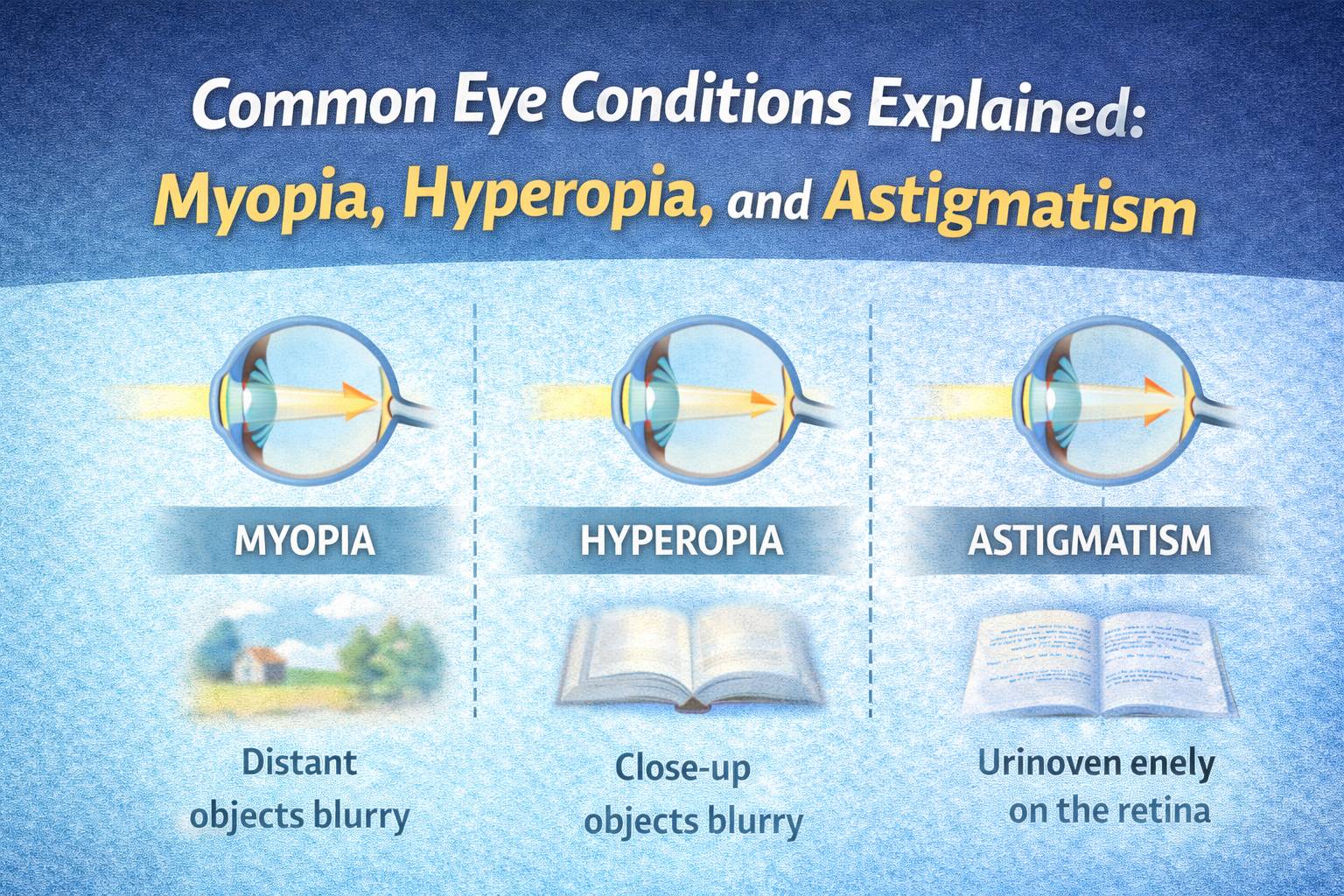
Common Eye Conditions Explained: Myopia, Hyperopia, and Astigmatism
A lot of people have vision problems, but not everyone knows what their diagnosis means. If you’ve ever been told you have myopia, hyperopia, or astigmatism, you might have nodded along during the eye exam while secretly wondering what those terms really mean. The good news is that these problems are very common and can usually be fixed with the right eye care.
Let’s talk about these three common vision problems in plain language so you can better understand how they affect your eyesight.
Myopia: When things that are far away look blurry
Myopia, also known as nearsightedness, is one of the most common vision problems today. People who are nearsighted can see things that are close to them very clearly, but things that are farther away, like road signs, classroom boards, or TV screens, may look blurry.
The shape of the eye makes light focus in front of the retina instead of directly on it. Because of this, things that are far away don’t look sharp.
Myopia usually starts in childhood and can get worse over time, especially in teens. Many eye care professionals around the world are seeing more cases of myopia because people are spending more time indoors and on screens.
The good news is that myopia is easy to fix. Prescription glasses, contact lenses, and sometimes special treatments like orthokeratology or refractive surgery can help you see clearly again at a distance. It’s important to have regular eye exams to keep an eye on changes and make sure your prescriptions are still correct.
Hyperopia: Trouble Seeing Things Up Close
Farsightedness, or hyperopia, is basically the opposite of myopia. People who are hyperopic usually see things that are far away better than things that are close by. Long periods of reading, using a phone, or working on a computer can make your eyes hurt, give you headaches, or make your vision blurry.
This happens when the eye is a little shorter than normal or when the cornea doesn’t curve as much. Because of this shape, light that comes into the eye focuses behind the retina instead of directly on it.
Some people with mild hyperopia may not notice big problems with their vision right away because their eyes can sometimes make up for it by changing focus. But over time, this extra work can make you tired and uncomfortable, especially when you’re doing things that require close attention.
Most of the time, corrective lenses are the best way to fix hyperopia. Glasses or contact lenses help light hit the retina in the right way, which makes things clearer for reading and other close-up tasks.
Astigmatism: When Your Vision Looks Weird
Astigmatism is another very common vision problem that often happens with myopia or hyperopia. Those who have astigmatism may see things that are blurry or distorted at all distances. At night, lights may look streaky, and it can be hard to read small text at times.
Astigmatism is when the cornea, which is the clear front part of the eye, doesn’t have a normal shape. It might not be perfectly round like a basketball; it could be more like a football. Because of this uneven curvature, light that enters the eye focuses on more than one point on the retina instead of just one.
This can make vision look a little blurry or out of focus.
Why It’s Important to Get Your Eyes Checked Regularly
Even though myopia, hyperopia, and astigmatism are common, you shouldn’t ignore them. A lot of people don’t know how much clearer things could look until they get the right prescription. Vision can change over time.
Regular eye exams can help find these problems early and make sure your vision stays clear and comfortable. During these visits, eye doctors can also look for other issues with your eyes. This is why it’s so important to get regular checkups for your health in general.